Gemini_Generated_Image_vf9avvvf9avvvf9a

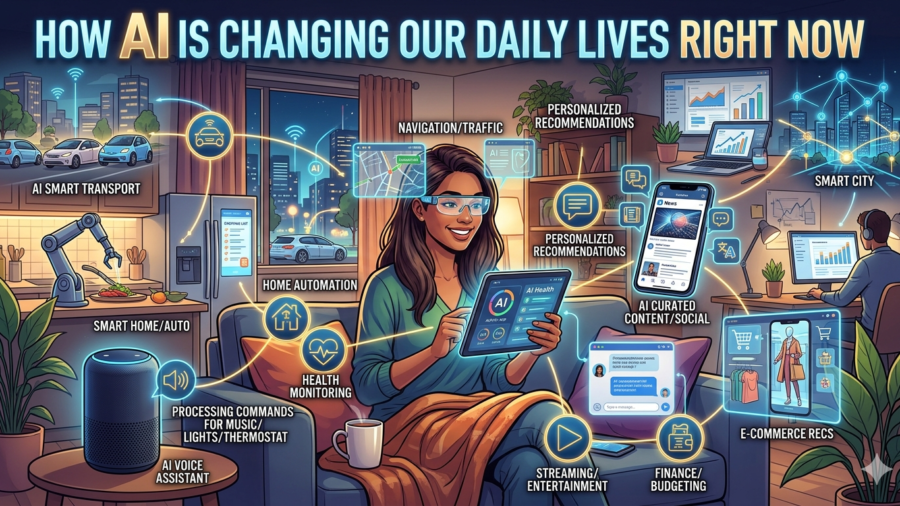
How AI is Changing Our Daily Lives Right Now

Introduction

Imagine your phone predicting the words you want to type, your favorite apps suggesting exactly the videos or songs you’ll love, or even a smartwatch notifying you when it’s time to exercise. Sounds futuristic? The truth is it’s happening right now.

Most people use AI-powered tools daily without realizing the scale of their impact. These systems influence not just convenience but also our decisions, habits, and even learning, work, and health. Ignoring AI’s role today means missing out on understanding a technology that is quietly shaping society.

This blog will explore concrete ways AI is transforming daily life, backed by examples and explanations, highlighting both its benefits and challenges while providing a realistic view of what the future might hold.

1. AI in Our Smartphones & Apps

AI is no longer limited to research labs; it has become the engine behind almost every smartphone feature.

  • Voice Assistants: Tools like Siri, Google Assistant, and Alexa use natural language processing (NLP) to understand speech and respond contextually. They now handle complex tasks like booking appointments, controlling smart devices, and even summarizing emails.
  • Predictive Typing & Autocorrect: AI models like GPT-based keyboards analyze typing patterns to suggest words or sentences, saving time and reducing errors.
  • Face Recognition & Security: Smartphones leverage AI-powered facial recognition and fingerprint mapping for secure authentication, replacing traditional passwords.
  • Personalized Experiences: AI algorithms analyze app usage to recommend features, optimize notifications, and adapt user interfaces for a more efficient experience.

Fact: A 2023 report shows that over 90% of smartphones use AI in at least one core feature, from camera enhancements to predictive text.

2. AI in Social Media & Entertainment

AI drives the personalization engines behind almost all content platforms today.

  • Content Recommendations: Platforms like TikTok, YouTube, and Instagram rely on AI to track user engagement, viewing time, and interaction patterns to serve videos tailored to interests.
  • Music & Video Personalization: Spotify, Netflix, and Apple Music analyze listening/viewing history and global trends to suggest what a user is most likely to enjoy next.
  • Content Creation & Filters: AI tools generate captions, remove background noise, enhance video resolution, or even create entirely new media assets, democratizing creativity for everyone.

Insight: AI doesn’t just make content convenient—it shapes cultural trends. Viral content often spreads due to algorithmic amplification rather than just popularity.


3. AI in Education & Learning

AI is revolutionizing education by making learning adaptive, personalized, and data-driven.

  • Adaptive Learning Platforms: AI tools like Khan Academy and Duolingo adjust difficulty and content based on student performance in real time.
  • AI Tutors & Homework Assistance: AI systems can explain complex topics, generate practice questions, and provide instant feedback.
  • Language Learning & Pronunciation: AI analyzes speech patterns, giving precise guidance on pronunciation, grammar, and vocabulary.
  • Data-Driven Insights: Teachers can use AI analytics to identify learning gaps and customize lesson plans for better student outcomes.

Fact: Studies suggest students using AI-assisted learning tools can improve retention by 30–50% compared to traditional methods.


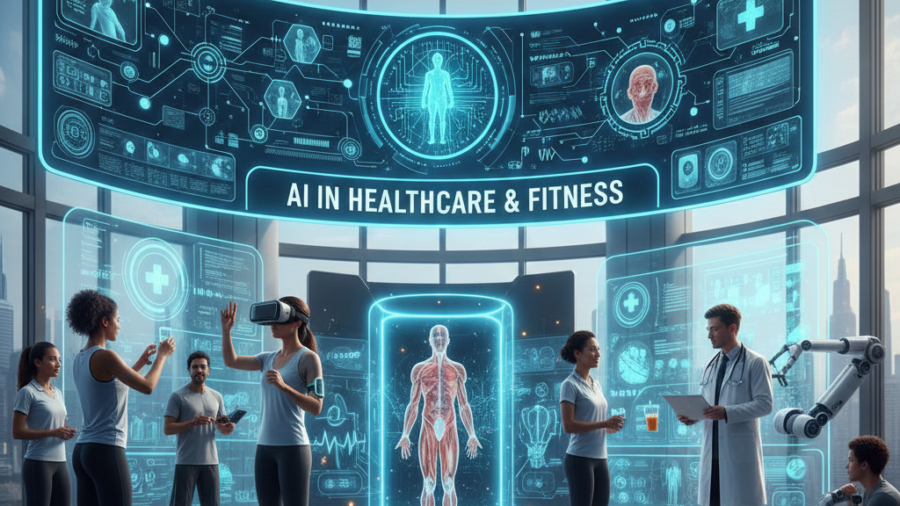
4. AI in Healthcare & Fitness

AI is transforming healthcare from reactive treatment to proactive monitoring and prediction.

  • Health Monitoring: Wearables like Apple Watch and Fitbit track heart rate, sleep, oxygen levels, and physical activity using AI algorithms to provide actionable insights.
  • Early Detection: AI models can analyze medical images, genetic data, and patient history to detect diseases like cancer or cardiovascular issues earlier than traditional methods.
  • Virtual Health Assistants: AI chatbots provide instant guidance, triage symptoms, and schedule appointments, improving accessibility to medical support.
  • Mental Health Support: Apps use AI to monitor mood patterns, suggest mindfulness exercises, and flag warning signs of stress or depression.

Insight: The WHO predicts AI in healthcare could save millions of lives annually by enhancing early detection and precision treatment.


5. AI in Shopping & Online Services

E-commerce and online services rely heavily on AI to enhance convenience and drive efficiency.

  • Product Recommendations: Amazon and Alibaba analyze browsing, purchase history, and global trends to suggest relevant products.
  • Chatbots & Customer Support: AI-powered chatbots answer queries instantly, handle complaints, and guide users, reducing the need for human agents.
  • Dynamic Pricing: AI adjusts prices based on demand, user behavior, and competitor data to maximize sales while remaining competitive.
  • Search Optimization: AI ensures that search results match user intent, even when queries are vague or misspelled.

Example: 35% of Amazon’s revenue reportedly comes from AI-powered product recommendations.


6. AI at Work & Productivity

AI is reshaping professional life by augmenting human capabilities.

  • Writing & Design: AI tools like ChatGPT, Canva, and Jasper help create documents, marketing content, and visuals faster.
  • Automation: Repetitive tasks like invoice processing, data entry, or report generation can be fully automated.
  • Smart Scheduling: Tools like x.ai or Clockwise optimize calendars, schedule meetings, and reduce conflicts.
  • Remote Collaboration: AI assists in summarizing meetings, translating languages, and enhancing communication in distributed teams.

Insight: Companies using AI in business processes report up to a 40% increase in productivity.


7. AI in Transportation & Navigation

AI improves efficiency and safety in everyday mobility.

  • Traffic & Route Optimization: Google Maps and Waze use AI to predict traffic patterns, recommend alternative routes, and reduce commute times.
  • Ride-Hailing Services: Uber and Lyft rely on AI to match drivers with passengers efficiently, optimize routes, and set dynamic pricing.
  • Autonomous Vehicles: While fully self-driving cars are still being tested, AI-driven features like lane assistance, collision warning, and autopilot are already in use.

Fact: AI-powered traffic optimization can reduce commute times by 15–20% in major cities.


8. Benefits of AI in Daily Life

  • Time-saving: AI handles mundane tasks so we can focus on higher-value work.
  • Enhanced Accuracy: Reduces human error in tasks like healthcare, finance, and navigation.
  • Personalization: Tailors experiences for education, shopping, entertainment, and fitness.
  • Opportunities: AI opens doors for creativity, innovation, and entrepreneurship.

9. Challenges & Concerns

Despite its advantages, AI comes with significant challenges:

  • Privacy & Data Security: Many AI systems rely on personal data, raising concerns about misuse.
  • Job Displacement: Automation could replace certain repetitive or routine jobs.
  • Over-reliance: Dependence on AI may reduce critical thinking and skill development.
  • Ethical & Bias Issues: AI can reinforce existing biases if training data is not properly curated.

Insight: Responsible AI development and literacy are crucial to maximize benefits while minimizing harm.


10. The Future: What’s Coming Next?

AI is poised to grow deeper into our lives:

  • Smarter Personal Assistants: AI that anticipates needs before we express them.
  • AI in Smart Homes & Cities: Optimizing energy, traffic, and urban planning.
  • Human-AI Collaboration: Teams of humans and AI working together for creativity and innovation.
  • Ethical AI: Ensuring AI is transparent, accountable, and aligned with human values.

Fact: Experts predict AI will contribute over $15 trillion to the global economy by 2030, affecting nearly every industry.


Conclusion

AI is no longer a futuristic concept—it’s a daily reality. From the apps on our phones to the tools at work, AI is quietly reshaping how we live, learn, work, and interact. Understanding its impact allows us to harness its power responsibly, enjoy its benefits, and prepare for a future where humans and AI collaborate more closely than ever.
Gemini_Generated_Image_npg4renpg4renpg4

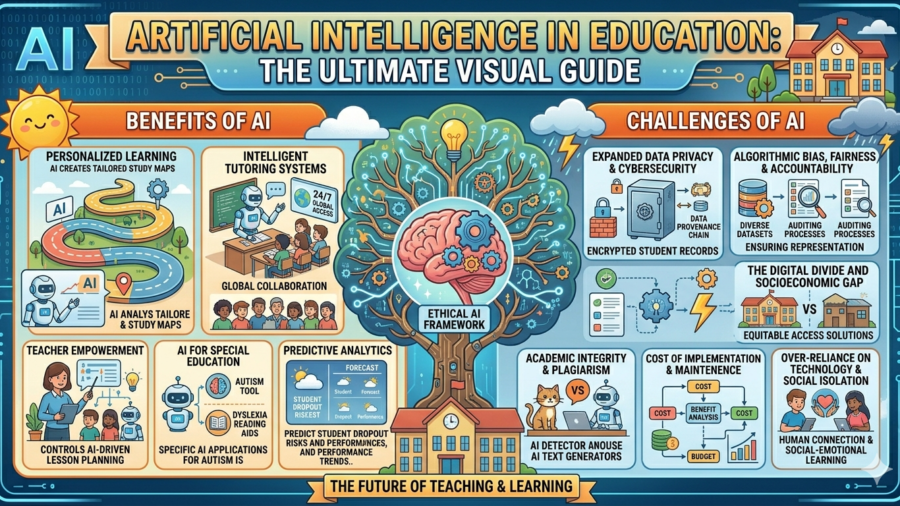
AI in Education: Benefits and Challenges The Complete Beginner’s Guide

Introduction: The Problem & the Promise

Classrooms are evolving. Conventional uniform lessons frequently result in students feeling disengaged or left out. Educators are overwhelmed, with grading, lesson preparation and attempting to provide attention to each student.

Artificial intelligence in education provides an answer: technologies that customize to individual students handle repetitive duties automatically and allow educators additional time for instruction. This article describes what AI in education entails, its mechanisms, genuine advantages potential hazards to consider and useful advice, for effectively implementing AI in educational settings.

________________________________________

What Is Artificial Intelligence in Education?

A simple explanation

Artificial Intelligence (AI) denotes computer programs capable of carrying out activities typically requiring intellect such, as speech recognition, content suggestion or problem-solving. Within education AI examines learning-related data. Applies this information to support both students and educators.

Ways AI is utilized in settings

AI assists by:

•          Adapting lessons to student skill levels.

•          Providing instant feedback on quizzes.

•          Powering virtual tutors and chatbots.

•          Automating grading for objective tasks.

•          Enabling smart classroom tools (like interactive boards and analytics dashboards).

Examples of AI tools used in education

•          Dynamic learning systems that adjust material according to the learners progress.

•          Online instructors available to respond to inquiries, around the clock.

•          Automated grading software for quizzes and programming assignments.

•          Analytics, from the classroom indicating the subjects students find challenging.

________________________________________

The Functioning of Education Prior, to AI

Traditional teaching methods

Instructors created lessons for the group. This approach was effective, for a not every student.

Manual grading and assessments

Grading especially for large classes was time-consuming and often delayed feedback.

Limited access to personalized learning

Customized assistance relied on teacher availability, small-group meetings or tutoring choices that were not consistently accessible or cost-effective.

________________________________________

Role of AI in Modern Education

AI isn’t sorcery. It provides teachers with innovative tools to enhance learning making it more intelligent and equitable. Presented below are the functions AI serves currently.

4.1 Personalized Learning

Customized learning paths

AI platforms develop customized lesson plans according to each students strengths and weaknesses. This allows learners to advance without experiencing pressure or boredom.

Learn at an individual pace

Learners have the ability to revisit lessons concentrate further on subjects and bypass content they have already mastered all directed by AI suggestions.

4.2 Smart Classrooms

AI-powered boards and tools

Smartboards are capable of identifying handwriting, capturing lesson screenshots and connecting with AI applications to provide resource recommendations.

Virtual classrooms

AI assists, in overseeing courses by arranging materials monitoring engagement and identifying learners who might be struggling.

4.3 Automated Grading & Feedback

Fast result generation

AI instantly scores multiple-choice exams. Can automatically evaluate code or math problems that have clear-cut solutions.

Instant feedback for students

When feedback is prompt students are able to fix mistakes away enhancing the retention of learning.

4.4 Virtual Tutors & Assistants

24/7 learning support

Virtual instructors respond to queries around the clock making them particularly useful, for studying or completing assignments.

Chatbots for student guidance

Chatbots are capable of assisting students with procedures offering study advice or explaining how to navigate learning platforms.

________________________________________

Benefits of AI in Education

AI offers significant advantages that are both practical and emotional, for students and educators.

•          Personalized learning experience

Learners gain material and exercises tailored to their requirements enhancing their confidence and advancement.

•          Time-saving for teachers

automating grading and routine tasks gives teachers time to focus on lesson design and one-on-one support.

•          Better student engagement

Engaging AI applications game-based exercises and personalized challenges maintain student enthusiasm.

•          24/7 learning access

Online instructors and cloud-based systems enable students to learn at any time and, from any location.

•          Improved learning outcomes

Test results and comprehension typically enhance when teaching aligns with student requirements and feedback is provided promptly.

Real-world example: A math app that adapts provides exercises to a student having difficulty, with fractions while moving another student forward to algebra ensuring both learners feel encouraged.

________________________________________

Challenges of AI in Education

AI holds potential yet it also presents significant challenges. Educational institutions and policymakers need to tackle these issues to ensure AI is employed safely and equitably.

•          High cost of AI tools

Advanced platforms, hardware, and maintenance can be expensive for schools with limited budgets.

•          Data privacy and security risks

Student information needs to be safeguarded. Mishandling data can damage privacy and confidence.

•          Lack of technical skills

Educators and school leaders require training to efficiently utilize AI tools.

•          Over-dependence on technology

Relying too much on AI can reduce critical thinking or interpersonal learning opportunities.

•          Possible job concerns for teachers

AI streamlines tasks,. It ought not to substitute educators. Concerns regarding employment stability are genuine. Need to be addressed through clear policies.

________________________________________

Impact of AI on Students and Teachers

Changes in teaching methods

Educators transition from acting as the providers of knowledge, to becoming facilitators, advisors and creators of educational experiences.

Improvement in student performance

Numerous organizations observe retention and increased scores when AI is utilized to tailor practice and provide immediate feedback.

Reduced workload for teachers

AI minimizes activities, like grading, attendance and simple reporting enabling teachers to concentrate on fostering classroom connections and creativity.

________________________________________

Is AI Replacing Teachers?

The importance of human teachers

No. Human educators provide compassion, moral discernment, encouragement and the capacity to instruct in skills—attributes that AI cannot authentically reproduce.

AI as a supporting tool

Consider AI as a teaching partner: it manages tasks and data processing allowing teachers to focus on what humans excel at—motivating, guiding and fostering connections.

Balance between technology and human teaching

The effective classrooms integrate AI technology alongside human understanding. Technology ought to support education than substitute the human interaction.

________________________________________

Future of AI in Education

The future holds both excitement and practicality. Anticipate witnessing:

• Intelligent educational platforms that forecast learning trajectories and provide career recommendations.

•          AI-based exams with dynamic question sets for fairer assessment.

•          Virtual reality (VR) + AI for immersive simulations in science, history, and vocational training.

These developments will keep enhancing accessibility and customization. They need to be applied with care.

________________________________________

Stepwise Tutorial: How Educational Institutions Can Begin Implementing AI (Hands-on)

1.        Assess needs and goals

Determine the areas where AI will be most beneficial: grading, engagement, remediation or administrative duties.

2.        Start small with free or low-cost tools

Pilot with one subject, one class, or a single tool like an adaptive practice app.

3.        Train teachers and staff

Provide workshops on using the tool, interpreting data, and protecting student privacy.

4.        Protect student data

Use secure platforms, set access controls, and comply with local privacy laws.

5.        Measure impact

Track engagement, test scores, and teacher satisfaction to decide whether to scale.

6.        Scale gradually

Expand successful pilots, keeping feedback loops with teachers and students.

________________________________________

Advantages and Disadvantages (Quick Comparison)

Advantages

•          Personalized learning at scale

•          Faster feedback for students

•          Reduced administrative workload for teachers

•          Greater access to learning resources anytime

Disadvantages

•          High initial cost for quality systems

•          Privacy and security risks with student data

•          Educator training necessary

•          Risk of reduced human interaction if misused

________________________________________

Image Suggestions (with ALT text)

1.        Image: A teacher using an interactive smartboard with students.

ALT: Teacher using AI-powered smartboard in classroom.

2.        Image: Student using a tablet with an adaptive learning app.

ALT: Student learning on tablet with adaptive AI app.

3.        Image: Virtual tutor chatbot conversation on a laptop.

ALT: Online tutor chat interface assisting a learner during nighttime.

4.        Image: Infographic of AI benefits vs challenges in education.

ALT: Infographic showing benefits and challenges of AI in education.

________________________________________

Internal Linking Suggestions (Anchor text ideas)

•          Link to: “EdTech Best Practices” for implementation tips.

•          Connect to: “How to Create Engaging Lesson Plans” for materials.

•          Link to: “Online Learning Tools” for software and app reviews.

(Use these anchors to connect readers to related posts on your Technology blog.)

________________________________________

External Linking Suggestions (Trusted resources)

•          Khan Academy: Adaptive learning and practice resources. (khanacademy.org)

•          UNESCO: Resources on digital education and policy. (unesco.org)

•          Edutopia:  Articles on AI and classroom strategies. (edutopia.org)

•          Microsoft Education / Google for Education: AI tools and case studies. (microsoft.com/education, edu.google.com)

(Link to high-authority domains to boost credibility and SEO.)

________________________________________

Practical Tips for Using AI in Education Effectively

• Employ AI as an assistant not, as an instructor. Allow AI to manage duties while educators guide the learning process.

•          Limit full dependence on AI. Keep human review for grading and sensitive decisions.

•          Protect student data. Use secure platforms and follow local laws.

•          Educate both instructors and learners. Ensure all parties understand how to operate the tools and analyze the outcomes.

•          Combine AI with traditional methods. Mix group work, discussions, and hands-on learning with AI-based practice.

•          Monitor and adapt. Use data to refine lessons, but preserve teacher judgment and empathy.

________________________________________

Conclusion. Achieving the Proper Balance Triumphs

AI in education offers a potential: customized learning, quicker feedback and less burden on teachers. However it also presents issues such as expenses, privacy concerns and the necessity, for teacher training.

The ideal future is one of balance. With AI serving as a helper while human educators continue to be central, to education. Begin with steps, safeguard student information and consistently emphasize the human connection that makes students feel recognized encouraged and inspired.

Call to Action:

If you are an educator consider launching an AI trial this semester and discuss the outcomes with your colleagues. If you are a student or a parent inquire with your school about how they safeguard student information and incorporate AI into education. Looking for a to-follow checklist to begin an AI trial in your class? Get our guide [link, to internal resource] or drop a comment below. I’ll assist you in outlining the initial steps.

________________________________________

Final SEO Notes (for your publishing checklist)

•          Incorporate the keyword AI in Education into the title opening paragraph no fewer than two H2/H3 headings and seamlessly 6–10 instances, throughout the article.

•          Use related keywords naturally across subheadings and body text (e.g., “Artificial Intelligence in Education,” “Benefits of AI in Education”).

•          Add alt text (provided) to each image for accessibility and SEO.

•          Link to at least two internal pages and two authoritative external sources.

•          Use brief paragraphs to enhance readability, on devices.

•          Add structured data (Article schema) and an FAQ schema for the FAQs to improve SERP features.

________________________________________

Should you wish I am able to:

•          Generate the downloadable checklist for your AI pilot (PDF).

•          Develop social media captions to advertise this post.

•          Create an SEO meta-title along, with headline options.

Which one of these do you want next?

FAQs — Frequently Asked Questions

1. Is it possible for AI to fully substitute teachers?

No. AI assists educators but cannot substitute compassion, imagination and guidance in the classroom.

2. Is AI safe for student data?

AI remains secure if platforms adhere to data privacy rules and educational institutions implement access restrictions.

3. Do students achieve improved learning outcomes with AI?

Numerous research projects and pilot programs demonstrate results when AI is applied to tailor learning and deliver prompt feedback.

4. What are affordable AI tools for schools?

Affordable and freemium adaptive learning applications, quiz tools and classroom helpers are well-suited for pilots.

5. Will artificial intelligence. Complicate exams?

AI has the ability to tailor tests to students by adjusting the difficulty according to their level making the assessments feel both tougher and more significant.

6. In what ways do educators get ready, for integrating AI into classrooms?

Training sessions, career growth opportunities and practical pilot programs enable educators to embrace AI tools with assurance.

7. What information about AI, in education is important for parents to understand?

Parents should ask about data privacy, how AI is used, and how it supports — not replaces — teacher guidance.

Gemini_Generated_Image_dzzt98dzzt98dzzt

The Impact of Generative AI, on Content Production

Picture a writing helper who never feels exhausted can produce images instantly and assists you in generating ideas at all times of the day. This is basically what generative artificial intelligence provides to content creators nowadays.

Generative AI denotes intelligence models capable of producing new material be it text, images, videos or audio according to the prompts and commands provided. In contrast, to AI, which only interprets data generative AI generates unique content that was not previously available.

The significance of AI in generating content has surged dramatically in years. Tasks that formerly required hours or even days are now achievable within minutes. This change is especially crucial since companies and individuals must generate content, than ever to remain competitive on the web.

The manner in which creators operate is undergoing a transformation. Than beginning with a blank sheet or canvas creators now collaborate with AI assistants that can produce initial drafts offer enhancement suggestions and even manage mundane content-related duties. This enables creators to concentrate on strategic thinking, creativity and infusing their distinctive human element into the content.

What is Generative AI?

Generative AI represents a form of intelligence that produces novel content by analyzing patterns within existing data. Imagine it as an intelligent learner who has studied millions of books examined countless images and absorbed thousands of hours of audio then applies that understanding to generate something original upon request.

A few used generative AI tools, among content creators nowadays are:

* **ChatGPT** \- for writing articles\, emails\, and social media posts

* **Midjourney** \- for creating artistic images and illustrations

* **DALL·E** \- for generating images from text descriptions

* **Jasper** \- specifically designed for marketing content

* **Canvas AI capabilities** \-, for creating designs and visual media

* **Synthesia** \- for creating AI\-powered videos with virtual presenters

The primary distinction between AI and generative AI is in their results. Conventional AI systems examine data. Offer insights or forecasts. For instance a conventional AI might indicate which kind of content yields the engagement on social media. Generative AI conversely generates that content, for you according to your requirements.

The Process of Content Creation Prior, to AI

Prior, to the access to generative AI creating content involved a significantly more hands-on and laborious effort. Authors dedicated time to investigating subjects composing text and revising their drafts. Designers produced each component individually. Assembled stock photos and visuals.

I recall that making a blog post could easily require 4-6 hours from beginning to end. This involved researching, writing, editing, sourcing images and arranging the layout. For creators and businesses it meant deciding between quality and volume either delivering excellent content at a slow pace or hurrying to meet the demand.

Independent creators and solo business owners encountered difficulties:

* Limited budgets for hiring professional writers or designers

* Limited time compelled them to prioritize either content production or other business activities

* Lack of specialized skills in areas like graphic design or video editing

* Difficulty maintaining consistent output across multiple platforms

Numerous creators ended up trapped in a loop aware they needed content to expand their audience but lacking the time or resources to produce it at the speed demanded by the current digital environment.

## The Impact of Generative AI, on Content Production Development

AI in Writing

Among all areas writing has likely undergone the significant change due to generative AI. This technology currently supports the creation of forms of written material:

**Blog writing** has become much quicker. AI assists in producing outlines drafting versions and even recommending enhancements for current content. Numerous bloggers now rely on AI to break through writers block or to develop content, in subjects where they possess knowledge.

**Social media captions** that once demanded effort and inventiveness can now be produced immediately. AI tools have the ability to generate caption options modify the tone to suit different platforms and even recommend hashtags aligned with the content.

**Product descriptions** for stores, which used to be repetitive and took a lot of time to produce can now be generated in large quantities. AI is capable of crafting descriptions for numerous products while preserving uniformity, in tone and style.

**Email marketing** initiatives gain from AI’s capacity to customize content and craft engaging lines. This technology can produce email series, newsletter text and follow-up communications tailored for audience groups.

AI in Image & Design Creation

AI tools capable of producing professional-grade images and designs, within minutes have transformed visual content creation.

**generated images** have unlocked opportunities that were once limited to individuals with expert photography or drawing abilities. Creators of content can now produce visuals that align exactly with their material without concern, for copyright restrictions or expenses related to stock photos.

**Logo and poster design** tools driven by AI can generate design options from basic text prompts. Small businesses unable to hire designers can now produce polished branding assets.

**Thumbnails, for YouTube** and various video sites can be produced swiftly using AI experimenting with designs and methods to determine what connects most effectively with viewers.

AI in Video & Audio Creation

Video and audio materials, which have typically demanded expertise and costly gear are now becoming easier to access thanks to AI.

**AI voiceovers** are capable of producing narration that sounds natural in languages and vocal styles. This feature is especially beneficial for creators who’re uneasy about recording their own voice or require content in languages unfamiliar, to them.

**Video scripts** can be produced according to subjects, intended viewers and targeted goals. AI is capable of crafting scripts for types of videos ranging from instructional materials, to marketing clips.

**AI-powered video editing** applications can automatically trim clips insert transitions and even create videos based on text instructions. This eliminates the obstacle that stopped many creators from making video content.

Benefits of Using Generative AI

The benefits of integrating AI into content production processes are significant and quantifiable.

**Time savings** likely stand out as the direct advantage. Tasks that used to require hours can now be finished within minutes. A social media manager who formerly dedicated a day to preparing a weeks posts can currently produce the identical content in less, than an hour.

**Boosted efficiency** logically results from saving time. Creators are able to generate content try various formats or concentrate on advanced strategic activities while AI manages the repetitive content creation.

**Cost savings** are crucial, for small enterprises and solo creators. Than outsourcing every content task to freelancers or agencies creators are able to manage a greater amount internally using AI support.

**Professional content for beginners** is now within reach. Individuals, without design skills can generate professional-quality graphics and inexperienced writers can craft content using AI support and editing.

24/7 availability implies that creators are not confined by working hours or geographical time differences. Concepts can be transformed into content instantly no matter when the spark of creativity occurs.

Challenges and Limitations of Generative AI

Although generative AI offers advantages it also presents challenges that creators must recognize and tackle.

Accuracy problems continue to be a worry. AI may produce information that’s factually wrong particularly regarding current events or niche subjects. Therefore creators must fact-. Validate AI-produced material prior, to release.

The absence of creativity is likely the most frequently mentioned drawback. Although AI can merge existing notions innovatively it finds it difficult to generate original creative ideas rooted in human feelings and experiences.

Plagiarism concerns emerge due, to AI models being trained on -existing material. There is a possibility that the produced content could closely resemble prior work raising potential legal or ethical challenges.

Excessive reliance, on AI may cause creators to lose their voice and abilities. Depending much on AI support poses the danger of struggling to produce content independently of these technologies.

Impact of Generative AI on Content Creators

Various categories of content creators are encountering effects due, to the introduction of AI.

Freelancers encounter both advantages and obstacles. Although AI tools enable them to operate productively and handle additional assignments they also confront heightened rivalry from clients who may opt to use AI rather than employ human creators.

Bloggers find AI useful, in getting past writers block and keeping a steady publishing routine. Nonetheless they must guarantee that their content retains a voice and viewpoint that differentiates it from AI-produced material.

**Digital marketers** employ AI to produce and evaluate a number of content variations resulting in enhanced performance and more informed decisions based on data. The capacity to rapidly create iterations of ads, emails and social media posts has boosted the success of campaigns.

Businesses and startups gain from AIs capacity to deliver content production without needing extensive creative staff. This somewhat evens the competition enabling firms to rival bigger corporations, in both the quantity and caliber of content.

Is Human Creativity Being Supplanted by Generative AI?

Although there are concerns regarding AI taking over human creators continue to be vital, for significant reasons.

Artificial intelligence cannot duplicate creativity and emotion. Although AI is capable of producing content that’s technically accurate it does not possess the personal experiences, feelings and distinctive viewpoints that render content genuinely captivating and relatable.

The importance of creativity and emotion in producing content extends past crafting text or visuals. It encompasses grasping audience requirements fostering bonds and shaping brand identities that connect with individuals.

AI serving as a tool is the most practical and advantageous strategy. Of substituting human creators AI is most effective when managing repetitive tasks producing preliminary concepts and offering a base that human creators can enhance and develop further.

I’ve observed that the content creators who achieve the success are those who consider AI a strong helper instead of a substitute, for their own talents and creativity. They utilize AI to manage the aspects of content production while dedicating their human effort to strategy, imagination and infusing personal elements that distinguish their content.

Future of Generative AI in Content Creation

The outlook for AI, in content production appears progressively advanced and embedded within creative processes.

Anticipated progress involves precision, in content creation, deeper comprehension of context and subtlety and a strengthened capability to preserve consistent brand tones throughout various content forms.

Customized content will grow increasingly common as AI technologies gain a grasp of individual audience tastes and can generate material designed specifically for particular users or audience groups automatically.

Automation driven by AI is expected to manage content workflows covering everything from the initial research and creation stages, to distribution and performance evaluation. This might involve automated content scheduling, content that adapts dynamically according to events and instant optimization driven by audience interaction.

Tips for Using Generative AI Effectively

To get the best results from generative AI tools, consider these practical approaches:

Employ AI, as a helper of a full answer. Begin with AI-produced material as a base then incorporate your knowledge, experiences and viewpoint to make it distinctive and meaningful.

Consistently. Review AI-produced text. Even top AI applications can. Generate content that doesn’t fully align with your desired tone or communication.

Combine human creativity with AI speed by using AI for initial drafts, brainstorming, and routine tasks, while applying your creative judgment for final decisions, strategic direction, and quality control.

Do not directly copy content** from AI tools. Rather treat AI-generated text as a starting point and raw material that you enhance and perfect using your skills.

Generative AI has revolutionized content production by enabling anyone to produce professional-grade material no their technical expertise or financial resources. This technology reduces time expenditure boosts efficiency and unlocks opportunities that were once, beyond the grasp of numerous creators.

Nevertheless the effective method, for using AI in content generation is not substitution. It is collaboration. The unique human qualities of creativity, emotion and strategic insight continue to be components that enable content to resonate with audiences.

As we move forward, the creators who thrive will be those who learn to effectively combine AI’s efficiency and capabilities with their own unique human perspectives and expertise. The future of content creation isn’t human versus AI – it’s humans working alongside AI to create better content than either could produce alone.