Introduction: The Problem & the Promise
Classrooms are evolving. Conventional uniform lessons frequently result in students feeling disengaged or left out. Educators are overwhelmed, with grading, lesson preparation and attempting to provide attention to each student.
Artificial intelligence in education provides an answer: technologies that customize to individual students handle repetitive duties automatically and allow educators additional time for instruction. This article describes what AI in education entails, its mechanisms, genuine advantages potential hazards to consider and useful advice, for effectively implementing AI in educational settings.
________________________________________
What Is Artificial Intelligence in Education?
A simple explanation
Artificial Intelligence (AI) denotes computer programs capable of carrying out activities typically requiring intellect such, as speech recognition, content suggestion or problem-solving. Within education AI examines learning-related data. Applies this information to support both students and educators.
Ways AI is utilized in settings
AI assists by:
• Adapting lessons to student skill levels.
• Providing instant feedback on quizzes.
• Powering virtual tutors and chatbots.
• Automating grading for objective tasks.
• Enabling smart classroom tools (like interactive boards and analytics dashboards).
Examples of AI tools used in education
• Dynamic learning systems that adjust material according to the learners progress.
• Online instructors available to respond to inquiries, around the clock.
• Automated grading software for quizzes and programming assignments.
• Analytics, from the classroom indicating the subjects students find challenging.
________________________________________
The Functioning of Education Prior, to AI
Traditional teaching methods
Instructors created lessons for the group. This approach was effective, for a not every student.
Manual grading and assessments
Grading especially for large classes was time-consuming and often delayed feedback.
Limited access to personalized learning
Customized assistance relied on teacher availability, small-group meetings or tutoring choices that were not consistently accessible or cost-effective.
________________________________________
Role of AI in Modern Education
AI isn’t sorcery. It provides teachers with innovative tools to enhance learning making it more intelligent and equitable. Presented below are the functions AI serves currently.
4.1 Personalized Learning
Customized learning paths
AI platforms develop customized lesson plans according to each students strengths and weaknesses. This allows learners to advance without experiencing pressure or boredom.
Learn at an individual pace
Learners have the ability to revisit lessons concentrate further on subjects and bypass content they have already mastered all directed by AI suggestions.
4.2 Smart Classrooms
AI-powered boards and tools
Smartboards are capable of identifying handwriting, capturing lesson screenshots and connecting with AI applications to provide resource recommendations.
Virtual classrooms
AI assists, in overseeing courses by arranging materials monitoring engagement and identifying learners who might be struggling.
4.3 Automated Grading & Feedback
Fast result generation
AI instantly scores multiple-choice exams. Can automatically evaluate code or math problems that have clear-cut solutions.
Instant feedback for students
When feedback is prompt students are able to fix mistakes away enhancing the retention of learning.
4.4 Virtual Tutors & Assistants
24/7 learning support
Virtual instructors respond to queries around the clock making them particularly useful, for studying or completing assignments.
Chatbots for student guidance
Chatbots are capable of assisting students with procedures offering study advice or explaining how to navigate learning platforms.
________________________________________
Benefits of AI in Education
AI offers significant advantages that are both practical and emotional, for students and educators.
• Personalized learning experience
Learners gain material and exercises tailored to their requirements enhancing their confidence and advancement.
• Time-saving for teachers
automating grading and routine tasks gives teachers time to focus on lesson design and one-on-one support.
• Better student engagement
Engaging AI applications game-based exercises and personalized challenges maintain student enthusiasm.
• 24/7 learning access
Online instructors and cloud-based systems enable students to learn at any time and, from any location.
• Improved learning outcomes
Test results and comprehension typically enhance when teaching aligns with student requirements and feedback is provided promptly.
Real-world example: A math app that adapts provides exercises to a student having difficulty, with fractions while moving another student forward to algebra ensuring both learners feel encouraged.
________________________________________
Challenges of AI in Education
AI holds potential yet it also presents significant challenges. Educational institutions and policymakers need to tackle these issues to ensure AI is employed safely and equitably.
• High cost of AI tools
Advanced platforms, hardware, and maintenance can be expensive for schools with limited budgets.
• Data privacy and security risks
Student information needs to be safeguarded. Mishandling data can damage privacy and confidence.
• Lack of technical skills
Educators and school leaders require training to efficiently utilize AI tools.
• Over-dependence on technology
Relying too much on AI can reduce critical thinking or interpersonal learning opportunities.
• Possible job concerns for teachers
AI streamlines tasks,. It ought not to substitute educators. Concerns regarding employment stability are genuine. Need to be addressed through clear policies.
________________________________________
Impact of AI on Students and Teachers
Changes in teaching methods
Educators transition from acting as the providers of knowledge, to becoming facilitators, advisors and creators of educational experiences.
Improvement in student performance
Numerous organizations observe retention and increased scores when AI is utilized to tailor practice and provide immediate feedback.
Reduced workload for teachers
AI minimizes activities, like grading, attendance and simple reporting enabling teachers to concentrate on fostering classroom connections and creativity.
________________________________________
Is AI Replacing Teachers?
The importance of human teachers
No. Human educators provide compassion, moral discernment, encouragement and the capacity to instruct in skills—attributes that AI cannot authentically reproduce.
AI as a supporting tool
Consider AI as a teaching partner: it manages tasks and data processing allowing teachers to focus on what humans excel at—motivating, guiding and fostering connections.
Balance between technology and human teaching
The effective classrooms integrate AI technology alongside human understanding. Technology ought to support education than substitute the human interaction.
________________________________________
Future of AI in Education
The future holds both excitement and practicality. Anticipate witnessing:
• Intelligent educational platforms that forecast learning trajectories and provide career recommendations.
• AI-based exams with dynamic question sets for fairer assessment.
• Virtual reality (VR) + AI for immersive simulations in science, history, and vocational training.
These developments will keep enhancing accessibility and customization. They need to be applied with care.
________________________________________
Stepwise Tutorial: How Educational Institutions Can Begin Implementing AI (Hands-on)
1. Assess needs and goals
Determine the areas where AI will be most beneficial: grading, engagement, remediation or administrative duties.
2. Start small with free or low-cost tools
Pilot with one subject, one class, or a single tool like an adaptive practice app.
3. Train teachers and staff
Provide workshops on using the tool, interpreting data, and protecting student privacy.
4. Protect student data
Use secure platforms, set access controls, and comply with local privacy laws.
5. Measure impact
Track engagement, test scores, and teacher satisfaction to decide whether to scale.
6. Scale gradually
Expand successful pilots, keeping feedback loops with teachers and students.
________________________________________
Advantages and Disadvantages (Quick Comparison)
Advantages
• Personalized learning at scale
• Faster feedback for students
• Reduced administrative workload for teachers
• Greater access to learning resources anytime
Disadvantages
• High initial cost for quality systems
• Privacy and security risks with student data
• Educator training necessary
• Risk of reduced human interaction if misused
________________________________________
Image Suggestions (with ALT text)
1. Image: A teacher using an interactive smartboard with students.
ALT: Teacher using AI-powered smartboard in classroom.
2. Image: Student using a tablet with an adaptive learning app.
ALT: Student learning on tablet with adaptive AI app.
3. Image: Virtual tutor chatbot conversation on a laptop.
ALT: Online tutor chat interface assisting a learner during nighttime.
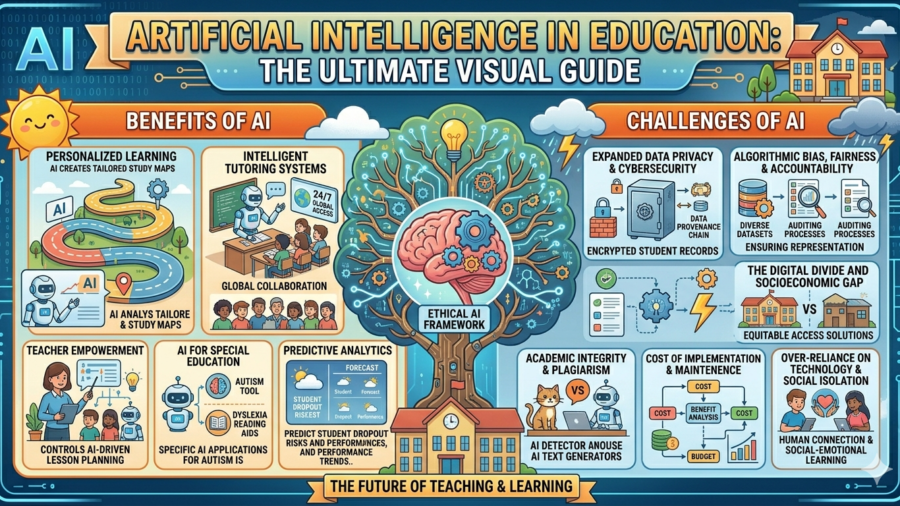
4. Image: Infographic of AI benefits vs challenges in education.
ALT: Infographic showing benefits and challenges of AI in education.
________________________________________
Internal Linking Suggestions (Anchor text ideas)
• Link to: “EdTech Best Practices” for implementation tips.
• Connect to: “How to Create Engaging Lesson Plans” for materials.
• Link to: “Online Learning Tools” for software and app reviews.
(Use these anchors to connect readers to related posts on your Technology blog.)
________________________________________
External Linking Suggestions (Trusted resources)
• Khan Academy: Adaptive learning and practice resources. (khanacademy.org)
• UNESCO: Resources on digital education and policy. (unesco.org)
• Edutopia: Articles on AI and classroom strategies. (edutopia.org)
• Microsoft Education / Google for Education: AI tools and case studies. (microsoft.com/education, edu.google.com)
(Link to high-authority domains to boost credibility and SEO.)
________________________________________
Practical Tips for Using AI in Education Effectively
• Employ AI as an assistant not, as an instructor. Allow AI to manage duties while educators guide the learning process.
• Limit full dependence on AI. Keep human review for grading and sensitive decisions.
• Protect student data. Use secure platforms and follow local laws.
• Educate both instructors and learners. Ensure all parties understand how to operate the tools and analyze the outcomes.
• Combine AI with traditional methods. Mix group work, discussions, and hands-on learning with AI-based practice.
• Monitor and adapt. Use data to refine lessons, but preserve teacher judgment and empathy.
________________________________________
Conclusion. Achieving the Proper Balance Triumphs
AI in education offers a potential: customized learning, quicker feedback and less burden on teachers. However it also presents issues such as expenses, privacy concerns and the necessity, for teacher training.
The ideal future is one of balance. With AI serving as a helper while human educators continue to be central, to education. Begin with steps, safeguard student information and consistently emphasize the human connection that makes students feel recognized encouraged and inspired.
Call to Action:
If you are an educator consider launching an AI trial this semester and discuss the outcomes with your colleagues. If you are a student or a parent inquire with your school about how they safeguard student information and incorporate AI into education. Looking for a to-follow checklist to begin an AI trial in your class? Get our guide [link, to internal resource] or drop a comment below. I’ll assist you in outlining the initial steps.
________________________________________
Final SEO Notes (for your publishing checklist)
• Incorporate the keyword AI in Education into the title opening paragraph no fewer than two H2/H3 headings and seamlessly 6–10 instances, throughout the article.
• Use related keywords naturally across subheadings and body text (e.g., “Artificial Intelligence in Education,” “Benefits of AI in Education”).
• Add alt text (provided) to each image for accessibility and SEO.
• Link to at least two internal pages and two authoritative external sources.
• Use brief paragraphs to enhance readability, on devices.
• Add structured data (Article schema) and an FAQ schema for the FAQs to improve SERP features.
________________________________________
Should you wish I am able to:
• Generate the downloadable checklist for your AI pilot (PDF).
• Develop social media captions to advertise this post.
• Create an SEO meta-title along, with headline options.
Which one of these do you want next?
FAQs — Frequently Asked Questions
1. Is it possible for AI to fully substitute teachers?
No. AI assists educators but cannot substitute compassion, imagination and guidance in the classroom.
2. Is AI safe for student data?
AI remains secure if platforms adhere to data privacy rules and educational institutions implement access restrictions.
3. Do students achieve improved learning outcomes with AI?
Numerous research projects and pilot programs demonstrate results when AI is applied to tailor learning and deliver prompt feedback.
4. What are affordable AI tools for schools?
Affordable and freemium adaptive learning applications, quiz tools and classroom helpers are well-suited for pilots.
5. Will artificial intelligence. Complicate exams?
AI has the ability to tailor tests to students by adjusting the difficulty according to their level making the assessments feel both tougher and more significant.
6. In what ways do educators get ready, for integrating AI into classrooms?
Training sessions, career growth opportunities and practical pilot programs enable educators to embrace AI tools with assurance.
7. What information about AI, in education is important for parents to understand?
Parents should ask about data privacy, how AI is used, and how it supports — not replaces — teacher guidance.